




Started By
Message

 0
0


Posted on 10/1/25 at 9:15 am to UKWildcats
Ok. Let's compare to your team's field (from what I've seen online):
Lindsey Nelson field Dimensions are:
Left - 320
Left-Center - 385
Center - 390
Right-Center - 365
Right - 320
Fence Height: 10.5'
Kentucky Proud Park field Dimensions are:
Left - 335
Left-Center - 375
Center - 400
Right-Center - 365
Right - 320
Fence Height: - Cannot find, but pictures look to be between 9.5' and 10'.
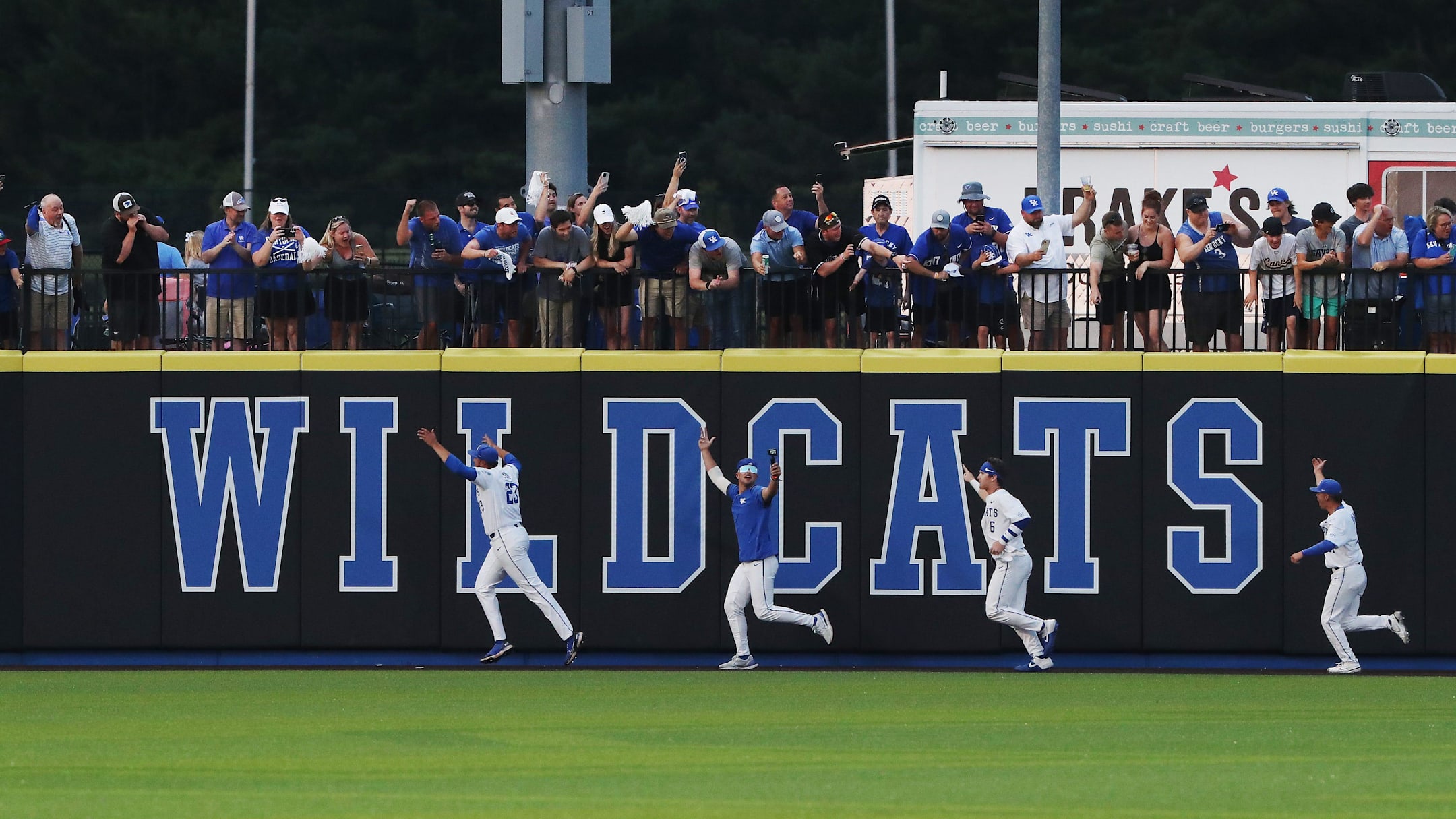
Here are some pictures of the outfield walls for comparison:
[

So, how does the outfield fence height correlate to distance in regards to necessary trajectory for a homerun? This just helps illustrate the physics, by illustrating the difference for a Homerun over the Center Field Wall.
Both distance and fence Height also play into things. Lindsey Nelson Stadium's fence is 10'5 feet high. I can't find info on the height of the fence at Kentucky Proud Park...but it would appear (from the pictures I can see) to be somewhere between 9.5’ to 10' tall. I will calculate for each scenario.
Using the formula h(t) = -½gt² + v0t + h0 you can calculate the minimum height required for a ball to clear a wall with a parabolic trajectory and an initial height of 3'.
In the equation:
h(t) = ball height at time t
g = acceleration due to gravity
vo = initial vertical velocity
h0 = initial height
So, to know when the ball reaches the fence height you solve for t using the formula: t = (-v0 ± v(v0² - 4(-½g)(h0 - h(t)))) / (2(-½g)).
Actually, backing into it to make it easier to visualize, a HR over the left center fence at Kentucky Proud Park must be just over 9.5 or 10' high at 400' from the point of contact, and at Lindsey-Nelson it must be just over 10.5' at 390 feet from the point of contact. Let's use the same angle of departure and calculate the different velocity needed for each field to have a HR at the point where the outfield wall distance varies the most.
If the fence height at Kentucky Proud Park, is 10' and distance (x) is 400', 10=3+0.2679(400)-16.1(400)(400) /(0.9330(v)(v)) just trying to make it clearer, since it's hard to put in subscript and superscript on the message boards...
So, for KPP a HR with this trajectory would need to have an exit speed of 166.3 f/s or 113.4 mph if the fence is 10’ tall.
If the fence height at Kentucky Proud, is 9.5' and distance (x) is 400', 9.5=3+0.2679(400)-16.1(400)(400) /(0.9330(v)(v)
So, for KPP a HR with this trajectory would need to have an exit speed of 165.6 f/s or 112.9 mph if the fence is 9.5’ tall.
Now for Lindsey Nelson Stadium, where the fence height is 10.5' and the distance is 390', 10.5=3+0.2679(390)-16.1(390)(390) /(0.9330(v)(v)).
For Lindsey Nelson, a HR with the same trajectory would need to exit at 164.4 f/s or 112.0 mph.
A HR at Kentucky Proud Park would leave the bat almost just under 1 mph faster than one from Lindsey Nelson if the fence is 9.5’ tall, and around 1.4 mph faster if it is 10’ tall.
Lindsey Nelson field Dimensions are:
Left - 320
Left-Center - 385
Center - 390
Right-Center - 365
Right - 320
Fence Height: 10.5'
Kentucky Proud Park field Dimensions are:
Left - 335
Left-Center - 375
Center - 400
Right-Center - 365
Right - 320
Fence Height: - Cannot find, but pictures look to be between 9.5' and 10'.
Here are some pictures of the outfield walls for comparison:
[
So, how does the outfield fence height correlate to distance in regards to necessary trajectory for a homerun? This just helps illustrate the physics, by illustrating the difference for a Homerun over the Center Field Wall.
Both distance and fence Height also play into things. Lindsey Nelson Stadium's fence is 10'5 feet high. I can't find info on the height of the fence at Kentucky Proud Park...but it would appear (from the pictures I can see) to be somewhere between 9.5’ to 10' tall. I will calculate for each scenario.
Using the formula h(t) = -½gt² + v0t + h0 you can calculate the minimum height required for a ball to clear a wall with a parabolic trajectory and an initial height of 3'.
In the equation:
h(t) = ball height at time t
g = acceleration due to gravity
vo = initial vertical velocity
h0 = initial height
So, to know when the ball reaches the fence height you solve for t using the formula: t = (-v0 ± v(v0² - 4(-½g)(h0 - h(t)))) / (2(-½g)).
Actually, backing into it to make it easier to visualize, a HR over the left center fence at Kentucky Proud Park must be just over 9.5 or 10' high at 400' from the point of contact, and at Lindsey-Nelson it must be just over 10.5' at 390 feet from the point of contact. Let's use the same angle of departure and calculate the different velocity needed for each field to have a HR at the point where the outfield wall distance varies the most.
If the fence height at Kentucky Proud Park, is 10' and distance (x) is 400', 10=3+0.2679(400)-16.1(400)(400) /(0.9330(v)(v)) just trying to make it clearer, since it's hard to put in subscript and superscript on the message boards...
So, for KPP a HR with this trajectory would need to have an exit speed of 166.3 f/s or 113.4 mph if the fence is 10’ tall.
If the fence height at Kentucky Proud, is 9.5' and distance (x) is 400', 9.5=3+0.2679(400)-16.1(400)(400) /(0.9330(v)(v)
So, for KPP a HR with this trajectory would need to have an exit speed of 165.6 f/s or 112.9 mph if the fence is 9.5’ tall.
Now for Lindsey Nelson Stadium, where the fence height is 10.5' and the distance is 390', 10.5=3+0.2679(390)-16.1(390)(390) /(0.9330(v)(v)).
For Lindsey Nelson, a HR with the same trajectory would need to exit at 164.4 f/s or 112.0 mph.
A HR at Kentucky Proud Park would leave the bat almost just under 1 mph faster than one from Lindsey Nelson if the fence is 9.5’ tall, and around 1.4 mph faster if it is 10’ tall.

Posted on 10/1/25 at 9:38 am to madmaxvol
The capacities of those so-called stadiums tell you all you need to know about the popularity of college baseball, even in the SEC.


Posted on 10/1/25 at 10:26 am to 6columns
quote:
The capacities of those so-called stadiums tell you all you need to know about the popularity of college baseball, even in the SEC.
Baseball is actually quite popular throughout most of the SEC.
SEC Baseball Average Attendance 2025
LSU: 11,071
Mississippi State: 11,000
Arkansas: 9,907
Ole Miss: 9,361
South Carolina: 7,183
Texas: 7,113
Texas A&M: 6,076
Florida: 5,940
Tennessee: 5,543
Auburn: 5,284
Alabama: 3,857
Vanderbilt: 3,593
Kentucky: 3,300
Oklahoma: 2,810
Georgia: 2,650
Missouri: 1,272


Posted on 10/2/25 at 1:50 pm to Patbull217
quote:
Tony Vitello name has been tossed in the SF GIANTS hat! If the job would be offered does he take it? and how out of whack would TN fans be!
And now the Braves
LINK


Posted on 10/2/25 at 1:55 pm to Jrv2damac
quote:
I didn't think MLB organizations hire college baseball coaches to come be their manager
This would have been unheard of 30 years ago. Nowadays, teams are willing to hire collegiate managers based on several metrics like clubhouse compatibility, personalities, and strategic output. All of the corporate buzzwords in play.
Posted on 10/2/25 at 1:56 pm to Nasty_Canasta

 Page 2 of 2


Popular
Back to top
 Follow SECRant for SEC Football News