




.jpg)
 1
1


Started By
Message
Coleman-Williams works on his eyes
Posted on 10/9/26 at 8:57 am
Posted on 10/9/26 at 8:57 am
LINK
...
What they found, stumbling into a new way to assess vision this summer using virtual reality, was incredible, Allen said. The issue they discovered wasn't unique to Coleman-Williams and it wasn't debilitating by any means. But college football at the elite level is a game of thin margins. A small change can often make a big difference.
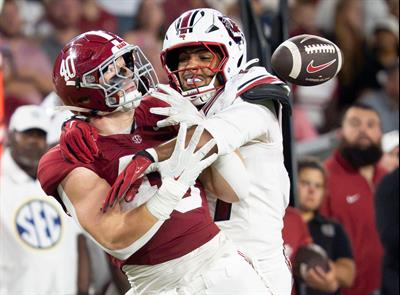
Coleman-Williams hasn't dropped a pass in four straight games -- twice as long as his longest stretch since the first month of his freshman season. He's caught at least one touchdown in three straight games -- also the longest streak since the first month of his freshman season.
"Now," Coleman-Williams said, "when it comes to the ball, I'm literally like Spider-Man. It's a lot easier. It's night and day."
"If it's legal and ethical," Allen said, "then we should be exploring it."
It's that ethos that got them started down this track. About a year and a half ago, Allen heard about a company that had developed virtual reality technology for elderly patients who suffered traumatic brain injuries to work on their reaction time and coordinated movement. It felt applicable to football players returning from lower-body injuries -- and so far it has been.
"Between you and me," Allen said, "I'd like to keep the name of the company off this."
For now, the secret is theirs, an advantage they'll guard for as long as possible.
This summer, though, the company that supplies the technology reached out to Allen with a question: Hey, by the way, did you know that the system has a way to assess vision?
No, he didn't.
And, yes, he was very much interested.
While everyone understands the importance of muscular and cardiovascular training in athletics, the idea of training our other organs -- our eyes and brain -- is mostly a foreign concept Allen has spent considerable time attempting to understand. It's why he's begun a cognitive performance science department that works under sports medicine.
Allen knew he wanted to test the vision assessment technology. One of the first people he went to was Coleman-Williams.
"Look," Allen told Coleman-Williams, "we don't know a lot about it. We think there may be something to it. We're going to test a bunch of guys. We want to test you and then we'll kind of go from there."
"Yeah," Coleman-Williams said, "let's try it."
What the system tests is what's called binocular motor control. Picture your left and right eye and how when an object comes closer to you, your eyes narrow and converge to track the object. That convergence influences depth perception.
The system is able to graph each eye's movements to see how well they're working in tandem. It looks kind of like an EKG or heart monitor with two lines -- left eye, right eye. When convergence is ideal, the lines are almost inseparable.
"And sure enough, we did some tests down there and the test showed that once the stimulus was right here," Coleman-Williams said, making a point with his finger a little more than an arm's length away from his face, "only one eye was tracking it."
Coleman-Williams wasn't alone with that issue on the team. And, keep in mind, it's not an all-or-nothing kind of thing. Like the 20/20 scale for a traditional eye test, there are degrees.
Identifying convergence insufficiency was a good first step.
"Well," Allen told the VR company, "now what?"
There were some rudimentary tools people can use to potentially improve their convergence. The primary device is called the Brock String, which is a simple white rope with three colored rings on it and has been around for more than a half century. The impact, however, is negligible.
Coleman-Williams dropped a pass in the season-opener against East Carolina last month.
But while Coleman-Williams was using the string to try to improve his vision, Allen told the company that he'd like them to create a training program for the VR headsets.
However many hundred keystrokes later and viola.
The program arrived before a Week 2 trip to Kentucky. To hear Allen describe it, it's nothing fancy. (Then again, he may be hiding more trade secrets.) Essentially the user puts on the VR goggles and is shown an object coming at them at varying speeds. By focusing on the act of tracking the object, over and over, the hope is that it trains the eyes to work better in tandem -- to converge as close to perfectly as possible.
Allen describes it as "dialing in" your eyesight. Most players use it for about 5 minutes per session, three sessions per week.
"I've done it myself," he said. "When you do the training, you come out and you're like, 'Wow.' I mean, there is definitely something to it. Imagine before you go sprint -- you're going to warm up. Well, we feel like there's a warmup part here, too, from between the brain and the central nervous system in terms of coordinating vision."
They can't score convergence yet but that's probably coming.
"As you're doing the test, I can watch the screen and I can see what your eyes are doing," Allen said. "Someone who is not converging, you'll see one eye move and the other eye kind of twitch or just stay there. And what we've seen with the guys who've done the training is that video, it looks incredibly different. They're both moving in a coordinated fashion, seamlessly right together. It's really remarkable."
In a matter of weeks, Coleman-Williams said he's cut the point where he might lose sight of an oncoming object in half. Now that point is consistently within his catch radius -- a spot where he should already have his hands on the football.
At one point, Coleman-Williams decided training three days wasn't enough.
"I want to do this on game day," he told Allen.
So they made the VR headsets available in the locker room.
...
...
What they found, stumbling into a new way to assess vision this summer using virtual reality, was incredible, Allen said. The issue they discovered wasn't unique to Coleman-Williams and it wasn't debilitating by any means. But college football at the elite level is a game of thin margins. A small change can often make a big difference.
Coleman-Williams hasn't dropped a pass in four straight games -- twice as long as his longest stretch since the first month of his freshman season. He's caught at least one touchdown in three straight games -- also the longest streak since the first month of his freshman season.
"Now," Coleman-Williams said, "when it comes to the ball, I'm literally like Spider-Man. It's a lot easier. It's night and day."
"If it's legal and ethical," Allen said, "then we should be exploring it."
It's that ethos that got them started down this track. About a year and a half ago, Allen heard about a company that had developed virtual reality technology for elderly patients who suffered traumatic brain injuries to work on their reaction time and coordinated movement. It felt applicable to football players returning from lower-body injuries -- and so far it has been.
"Between you and me," Allen said, "I'd like to keep the name of the company off this."
For now, the secret is theirs, an advantage they'll guard for as long as possible.
This summer, though, the company that supplies the technology reached out to Allen with a question: Hey, by the way, did you know that the system has a way to assess vision?
No, he didn't.
And, yes, he was very much interested.
While everyone understands the importance of muscular and cardiovascular training in athletics, the idea of training our other organs -- our eyes and brain -- is mostly a foreign concept Allen has spent considerable time attempting to understand. It's why he's begun a cognitive performance science department that works under sports medicine.
Allen knew he wanted to test the vision assessment technology. One of the first people he went to was Coleman-Williams.
"Look," Allen told Coleman-Williams, "we don't know a lot about it. We think there may be something to it. We're going to test a bunch of guys. We want to test you and then we'll kind of go from there."
"Yeah," Coleman-Williams said, "let's try it."
What the system tests is what's called binocular motor control. Picture your left and right eye and how when an object comes closer to you, your eyes narrow and converge to track the object. That convergence influences depth perception.
The system is able to graph each eye's movements to see how well they're working in tandem. It looks kind of like an EKG or heart monitor with two lines -- left eye, right eye. When convergence is ideal, the lines are almost inseparable.
"And sure enough, we did some tests down there and the test showed that once the stimulus was right here," Coleman-Williams said, making a point with his finger a little more than an arm's length away from his face, "only one eye was tracking it."
Coleman-Williams wasn't alone with that issue on the team. And, keep in mind, it's not an all-or-nothing kind of thing. Like the 20/20 scale for a traditional eye test, there are degrees.
Identifying convergence insufficiency was a good first step.
"Well," Allen told the VR company, "now what?"
There were some rudimentary tools people can use to potentially improve their convergence. The primary device is called the Brock String, which is a simple white rope with three colored rings on it and has been around for more than a half century. The impact, however, is negligible.
Coleman-Williams dropped a pass in the season-opener against East Carolina last month.
But while Coleman-Williams was using the string to try to improve his vision, Allen told the company that he'd like them to create a training program for the VR headsets.
However many hundred keystrokes later and viola.
The program arrived before a Week 2 trip to Kentucky. To hear Allen describe it, it's nothing fancy. (Then again, he may be hiding more trade secrets.) Essentially the user puts on the VR goggles and is shown an object coming at them at varying speeds. By focusing on the act of tracking the object, over and over, the hope is that it trains the eyes to work better in tandem -- to converge as close to perfectly as possible.
Allen describes it as "dialing in" your eyesight. Most players use it for about 5 minutes per session, three sessions per week.
"I've done it myself," he said. "When you do the training, you come out and you're like, 'Wow.' I mean, there is definitely something to it. Imagine before you go sprint -- you're going to warm up. Well, we feel like there's a warmup part here, too, from between the brain and the central nervous system in terms of coordinating vision."
They can't score convergence yet but that's probably coming.
"As you're doing the test, I can watch the screen and I can see what your eyes are doing," Allen said. "Someone who is not converging, you'll see one eye move and the other eye kind of twitch or just stay there. And what we've seen with the guys who've done the training is that video, it looks incredibly different. They're both moving in a coordinated fashion, seamlessly right together. It's really remarkable."
In a matter of weeks, Coleman-Williams said he's cut the point where he might lose sight of an oncoming object in half. Now that point is consistently within his catch radius -- a spot where he should already have his hands on the football.
At one point, Coleman-Williams decided training three days wasn't enough.
"I want to do this on game day," he told Allen.
So they made the VR headsets available in the locker room.
...
Posted on 10/9/26 at 9:21 am to Night Vision
quote:
However many hundred keystrokes later and viola.
viola? not voila?

Posted on 10/9/26 at 9:26 am to theballguy

Posted on 10/9/26 at 9:48 am to Night Vision
How did my thread disappear... When I posted no body posted it. ??
Posted on 10/9/26 at 9:49 am to Panthers4life
Mine was first. Yours got locked. If it's gone the admins deleted it.
Posted on 10/9/26 at 10:31 am to Night Vision
Well damn. Alright then.

 Page 1 of 1


Latest Alabama News


Popular
Back to top
 Follow SECRant for SEC Football News