BrohanDavey
| Favorite team: | LSU  |
| Location: | The Land Down Under |
| Biography: | Duke of the Republic of West Florida |
| Interests: | |
| Occupation: | Legal Stuff |
| Number of Posts: | 836 |
| Registered on: | 10/28/2018 |
| Online Status: | Not Online |
Recent Posts
Message
re: What’s the campus vibe
Posted by BrohanDavey on 9/26/26 at 10:44 am to DustyDinkleman
quote:
A lot of corn dogs. Texas A&M fans are elated.
They do love phallic-shaped objects like nobody else

 0
0
re: TEXAS!!
Posted by BrohanDavey on 9/26/26 at 10:37 am to BigBro
The universal constant in the SEC is that the Yell Leaders are cringe and weird asf.

re: Gameday Getting Harder and Harder to Watch
Posted by BrohanDavey on 9/26/26 at 10:00 am to Cheese Grits
quote:
Did she have 2 teeth?
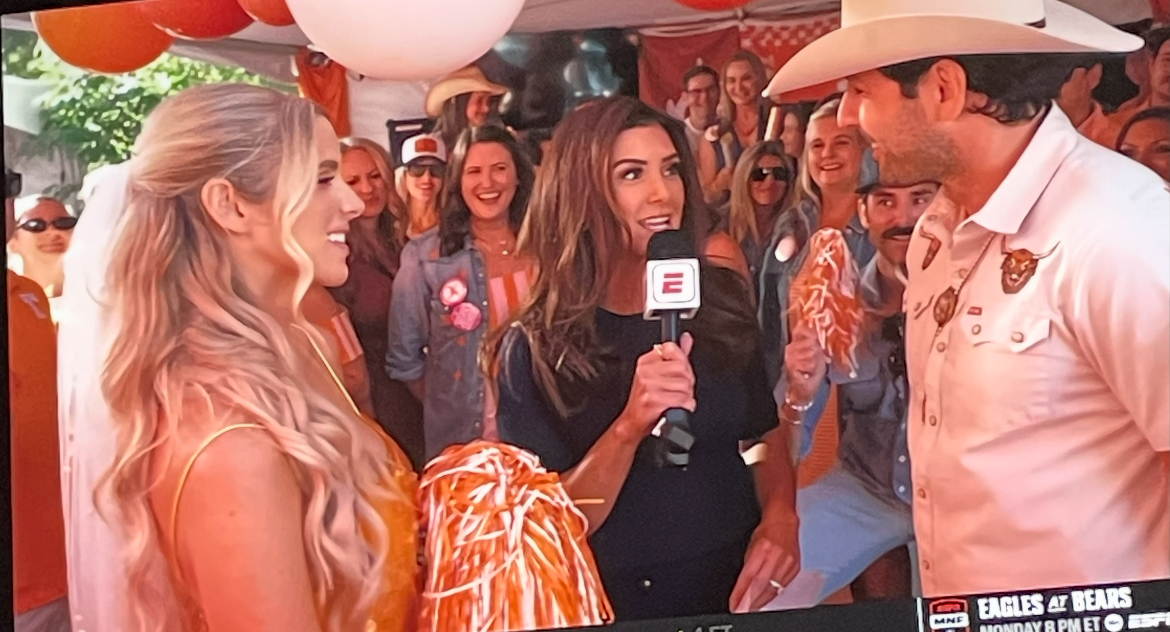
Looks like veneers from this angle. But she’s hot. Apologies for lacking a pic on the OP.
re: Can’t Help But Like Peyton M
Posted by BrohanDavey on 9/26/26 at 9:49 am to geauxbrown
quote:
genuine
Yes.
quote:
baw
No.
re: Gameday Getting Harder and Harder to Watch
Posted by BrohanDavey on 9/26/26 at 9:48 am to PistoleroPerro
quote:
Really should have never expanded to 3 hours.
Yep. It was never about football—it was 100% about Disney milking the cash cow.
Gameday Getting Harder and Harder to Watch
Posted by BrohanDavey on 9/26/26 at 9:40 am
ESPN has essentially turned it into The Today Show with football thrown in. Instead of analyzing football, they dedicate massive chunks of the broadcast to forced celebrity cross-promotion, endless sob stories, and weird crap.
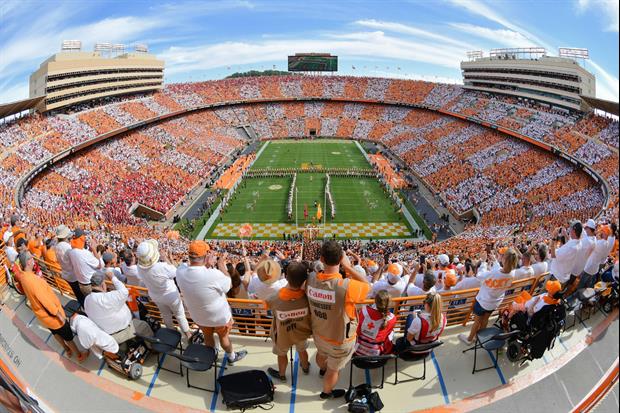
Case in point: this morning's broadcast in Knoxville for the Texas/Tennessee game. Jen Lada spent actual airtime covering a "wedding tailgate" for a Tennessee fan (Claire) and a Texas fan (Kris). ESPN’s press room stated that they had already eloped in Austin last month. A rather pointless bit if you ask me.
Gone are the days of Xs and Os and Corso mascot heads.
Case in point: this morning's broadcast in Knoxville for the Texas/Tennessee game. Jen Lada spent actual airtime covering a "wedding tailgate" for a Tennessee fan (Claire) and a Texas fan (Kris). ESPN’s press room stated that they had already eloped in Austin last month. A rather pointless bit if you ask me.
Gone are the days of Xs and Os and Corso mascot heads.
re: Any good looking ladies in the stands OM tonight?
Posted by BrohanDavey on 9/20/26 at 11:50 am to HenryParsons
You can feel the Botox just by looking at her.
re: The 3rd and 2 call……
Posted by BrohanDavey on 9/20/26 at 11:48 am to Big EZ Tiger
quote:
Leavitt missing some open guys didn't help
No doubt. Throws could have been better, although they appeared to be catchable.
re: Ole Miss made huge recruiting mistake
Posted by BrohanDavey on 9/20/26 at 11:44 am to TeeteringBrink
quote:
They got to see what a piss poor gameday environment in our pathetic little high school stadium is like.
quote:
No way any player visiting would ever choose to play for us when they could go to the just different heaven in Baton Rouge.
Agreed
re: The 3rd and 2 call……
Posted by BrohanDavey on 9/20/26 at 11:43 am to pkf4lsu
I was scratching my head about that. We ran that play with the same personnel and formation. Found it to be rather predictable since the only other time we ran that play was for a TD.
re: LSU would’ve rushed the field if at home.
Posted by BrohanDavey on 9/20/26 at 11:04 am to hughfreezehotline
quote:
Little brother shite
You have three recognized national championships, one of which is shared with Minnesota. Congrats on the win, but pipe down, lil bro.

Before people panic about the Ole Miss loss, look at the 2007 Saban parallel...
Posted by BrohanDavey on 9/20/26 at 10:46 am
I know dropping that game to Ole Miss yesterday stings, but take a step back and look at the bigger picture. Kiffin’s start here at LSU is eerily similar to Nick Saban’s first year at Alabama.
Think about the 2007 season. Saban takes over at Bama, plays LSU in his first year, and what happened? He lost 41-34. Saban was going up against a roster loaded with veteran guys he originally recruited to Baton Rouge.
Sounds familiar? Kiffin just walked into Oxford yesterday and took a loss against a veteran, win-now roster that he spent the last few years building while competing with a team he’s still building.
Silver lining: just like Saban's old recruits eventually cycled out of LSU, Kiffin's old recruits and portal players are about to leave Oxford en masse. Ole Miss is going to have to replace basically their entire offensive production next year. For what it’s worth, Ole Miss returned 61% of its roster from a year ago; LSU returned less than half of its roster.
1) Trinidad Chambliss is finally out of eligibility (his clock has completely run out and he will not be granted a 37th year of eligibility by a backwoods Mississippi judge).
2) Kewan Lacy is most likely declaring for the draft because he’s the best running back in the country.
3) Their starting tight end is a senior who could return under the NCAA five-for-five rule or go pro.
4) That Ole Miss defense is heavily anchored by at least five seniors who could very well be gone after this season.
The cycle is resetting right in front of us. The old team gets one last ride to win the first game using the elite talent the coach left behind. But once those players leave in the offseason, the new coach just starts beating the dog out of his old team. Saban did it to us, and Kiffin is about to do it to Ole Miss. Geaux Tigers.
Think about the 2007 season. Saban takes over at Bama, plays LSU in his first year, and what happened? He lost 41-34. Saban was going up against a roster loaded with veteran guys he originally recruited to Baton Rouge.
Sounds familiar? Kiffin just walked into Oxford yesterday and took a loss against a veteran, win-now roster that he spent the last few years building while competing with a team he’s still building.
Silver lining: just like Saban's old recruits eventually cycled out of LSU, Kiffin's old recruits and portal players are about to leave Oxford en masse. Ole Miss is going to have to replace basically their entire offensive production next year. For what it’s worth, Ole Miss returned 61% of its roster from a year ago; LSU returned less than half of its roster.
1) Trinidad Chambliss is finally out of eligibility (his clock has completely run out and he will not be granted a 37th year of eligibility by a backwoods Mississippi judge).
2) Kewan Lacy is most likely declaring for the draft because he’s the best running back in the country.
3) Their starting tight end is a senior who could return under the NCAA five-for-five rule or go pro.
4) That Ole Miss defense is heavily anchored by at least five seniors who could very well be gone after this season.
The cycle is resetting right in front of us. The old team gets one last ride to win the first game using the elite talent the coach left behind. But once those players leave in the offseason, the new coach just starts beating the dog out of his old team. Saban did it to us, and Kiffin is about to do it to Ole Miss. Geaux Tigers.
re: What's Up with All of the Long-form Social Media Posts by Women These Days?
Posted by BrohanDavey on 9/17/26 at 1:37 pm to PrettyBird
quote:
The IRONY of your post.
Exactly. I used AI to show how easy it is for people (women, in this case) to create social media slop.
re: What's Up with All of the Long-form Social Media Posts by Women These Days?
Posted by BrohanDavey on 9/17/26 at 8:04 am to shutterspeed
quote:
These all have to be AI generated, right?
It is. But that’s just the tip of the iceberg. Being a woman in 2026 is a business model, driven by AI and affiliate links.
1. Women use AI to do the heavy lifting.
They don't even write this stuff anymore. Anyone can type "write a profound, 300-word post about the mental load of motherhood" or whatever the latest fad in the women’s hemisphere is and get a perfectly spaced, emotionally manipulative essay in four seconds. Then when you talk to a woman like that in public, you realize how vapid and self-absorbed she is.
2. The GRWM / LTK grift.
Why pair a heavy trauma dump with a makeup tutorial? The vanity video stops the scroll, the emotional story builds fake intimacy, and then the viewer clicks the LikeToKnowIt link to buy the $40 concealer they're using. They are monetizing vulnerability and feeding into the trauma craze that is “‘my truth” vs. others truth because “lived experiences” or something like that.
3. "My therapist said..."
Therapy-speak is the ultimate shield. You can't call out their narcissism or bad takes if it's framed as a fragile mental health breakthrough from a medical professional. Looney tunes, the lot of them.
4. The "Daddy's Girl" Humble-Brag.
The "my dad raised me to believe I could do anything" trope is just an algorithm-friendly excuse to post a hot vanity pic or vacation flex. It disguises self-promotion as "empowerment." These are the same women who, at the same time, harbor resentment toward men because they think men simply view them as a piece of arse. Well golly gee, Megan, maybe don’t post a workout video of you at the gym hitting planks with the phone looking straight down your cleavage.
5. Cosmetic procedures as “self-care.”
People used to hide their Botox and nose jobs. Now they vlog the entire procedure from the medspa chair. They frame it as "just being transparent with y'all!" or "empowerment," but it's really just a sponsored ad for their injector disguised as a brave act of self-love. The OT 6 thinks she’s suddenly a solid 9.
It feels fake because it is. It’s not a diary anymore; it’s a highly curated, highly engineered sales funnel in the world of “influencers.”
re: LSU Alumni Tailgate at Lyric Theater
Posted by BrohanDavey on 9/16/26 at 1:49 pm to Reservoirdog
Oxford is notorious for outrageous cover charges at bars. Usually $20-50 for a regular night and $100-200 for big gameday weekends.
re: Question for the lawyers regarding Princewill
Posted by BrohanDavey on 9/16/26 at 1:29 pm to tomcatrav
quote:
does the perception of pettiness and/or gamesmanship work against the plaintiff’s case?
Contract law is generally objective, i.e., you look to the terms of the contract. A breach is a breach, and the subjective motivation of the plaintiff—even if spiteful or petty—does not automatically invalidate a legally binding agreement. However, in the real-world arena of civil litigation, blatant gamesmanship can absolutely work against a plaintiff.
If Ole Miss behaves in a highly punitive, theatrical manner—like intentionally timing the service of process to maximize a player's emotional distress or distraction right before a major rivalry game, which the folks in Oxfart did—it plays directly into the defense's hands. Defense counsel can point to this behavior as evidence that the university's overarching intent, including the buyout clause itself, is purely punitive.
Contracts carry an implied covenant of good faith and fair dealing. While filing a lawsuit to enforce a contract is not inherently bad faith, utilizing aggressive, hyper-public tactics to execute the litigation can blur the lines. It allows the defense to frame the plaintiff as an untrustworthy, vindictive actor rather than an aggrieved business partner
Just looking at the mechanics of this lawsuit, it’s a standard civil breach of contract claim, but with a massive SEC revenue-sharing twist.
For Ole Miss to actually win this, they have to prove three basic things: (1) the January 3rd contract was valid, (2) Umanmielen broke the 90-day retention clause by jumping to Baton Rouge in late January, and (3) that OM actually suffered $550k in damages.
But here are the two giant legal hurdles they have to clese:
(1) Did they even pay him?
If OM didn't actually hand over any cash before he entered the portal, they are going to have a brutal time proving they suffered half a million in actual harm. You can't usually enforce a massive buyout if no money actually changed hands.
(2) Is it just a penalty?
Courts routinely strike down "liquidated damages" if they figure out it's just an arbitrary penalty designed to trap a player on the roster rather than replace actual financial loss.
The bottom line: This isn't really about squeezing $550k out of a college kid's pocket. We already told OM to kick rocks back in March when they asked us to pay the buyout. This litigation looks like a backdoor maneuver to force that $550k onto our own revenue-sharing cap.
re: This is the best summation of the current SEC vs LSU situation posted yet.
Posted by BrohanDavey on 9/9/26 at 10:39 am to Raoul_Duke
quote:
But the SEC is trying to at least do something about it.
The only thing the SEC has done is overreach their legal authority and immediately get knocked down in court. Slapping together arbitrary rulings isn't "strong leadership"—it's an administrator panicking because the old power structure is crumbling.
quote:
We’re using this incident to make sure that the SEC has death penalty power over all 16 schools and none of them can go rogue.
Who the hell is “we”? You are sitting on a message board in your mother’s basement with a bad internet connection typing in grease-stained sweatpants—you aren’t at SEC HQ in Birmingham, you didn’t file any lawsuits, and Sankey doesn't know you exist.
re: SEC looking for "contrition" out of LSU before Thursday's vote
Posted by BrohanDavey on 9/8/26 at 4:40 pm to bstaceyau19
quote:
Is that even a thing? A civil RICO complaint? The C in RICO stands for "criminal"
It is. The “C” in RICO stands for Corrupt: the Racketeer Influenced and Corrupt Organizations Act.
re: Does big TV money (ABC/ESPN) tell Sankey to chill out?
Posted by BrohanDavey on 9/8/26 at 4:36 pm to SuperFanDan
quote:
Does big TV money (ABC/ESPN) tell Sankey to chill out?
quote:
I mean, they ultimately pay all the bills. I'm sure they could win this d$%@ measuring contest if they want to.
Yes, big Money TV tells him to get fricked.
Brooks Nader is on Hulu.
Hulu is owned by Disney.
ESPN is owned by Disney.
LSU is a member of SEC.
SEC has media deal with ESPN.
Disney owns LSU and Brooks Nader.
Brooks Nader went down victory hill with LSU.
Greg Sankey doesn’t stand a chance
re: SEC looking for "contrition" out of LSU before Thursday's vote
Posted by BrohanDavey on 9/8/26 at 4:13 pm to GeneralLee
quote:
**** these guys, this is clearly collusion and racketeering. If I'm LSU I tell them to pound sand.
You know, LSU bringing a civil RICO complaint isn’t as far fetched as one would think.
The SEC isn't operating like a voluntary sports association—it is functioning as a centralized cartel weaponizing economic extortion to crush member institutions. By threatening to strip half of LSU's athletic revenue, suspend its head coach, and orchestrate an emergency expulsion vote solely because the university complied with a valid state court order, Greg Sankey and Birmingham are engaging in classic Hobbs Act coercion: using severe financial ruin to force a state entity to surrender its legal rights. Hiding an extractive, multi-billion-dollar media monopoly behind the fraudulent pretext of "preserving amateurism" while abusing market power to bypass state jurisdiction isn't legitimate sports governance; it is a corporate protection racket using fear and administrative bullying to demand total compliance.
re: What circuit court does the Alabama court fall under?
Posted by BrohanDavey on 9/8/26 at 4:08 pm to vl100butch
quote:
Wonder where the LSU appeal would go to if necessary
11th Circuit. Of course, a lot can happen before then.
For one, LSU could and should file a motion to transfer venue under 28 U.S.C. § 1404 to another federal court such as the Middle District of Louisiana in Baton Rouge. Assuming the motion is granted, the case is tried, and a verdict is rendered and appealed, you’re in the 5th Circuit.
Popular
 18
18